
 |
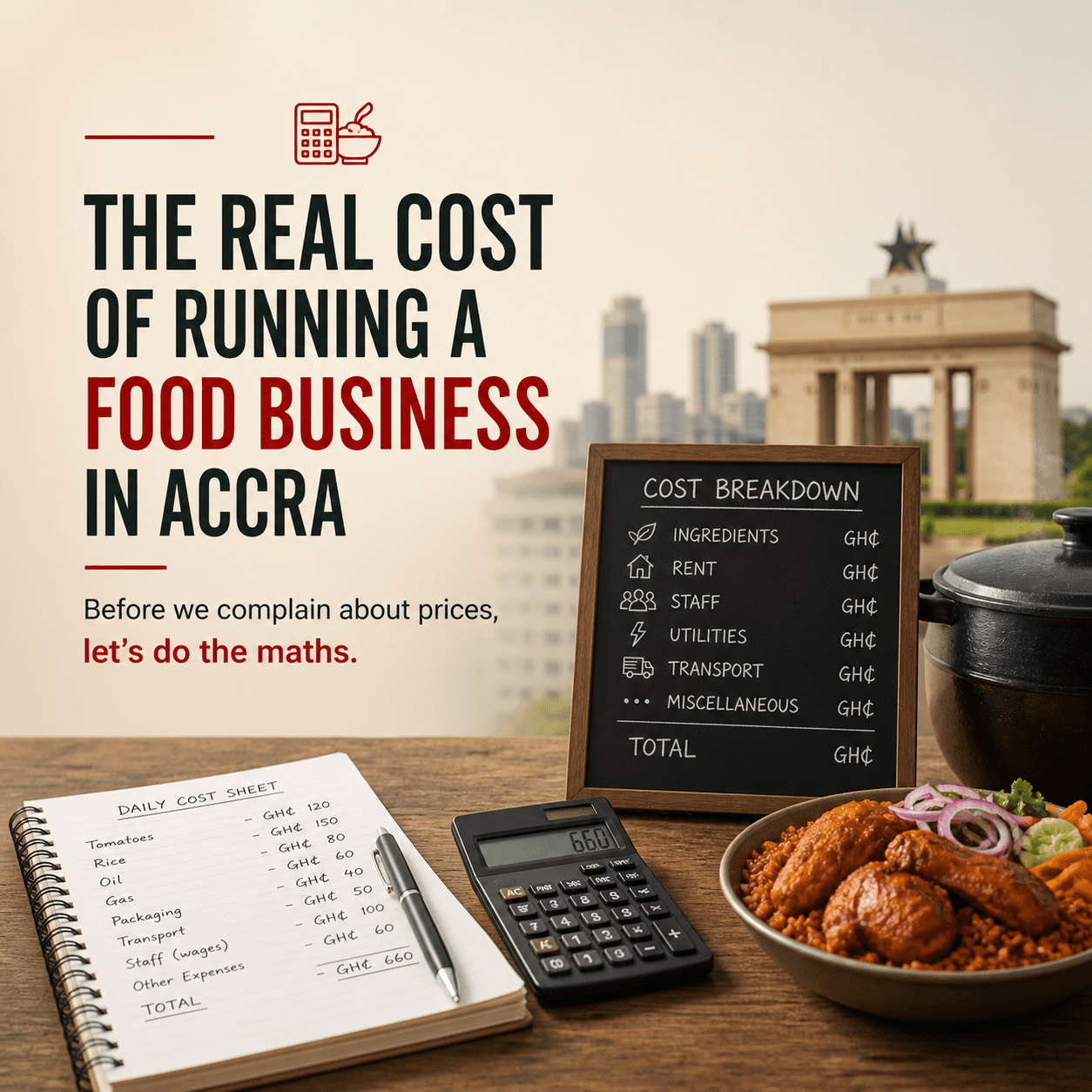
| The Real Cost of Running a Food Business in Accra: Before We Complain About Prices, Let’s Do the Maths-Nsemkeka |
Let me be honest, I see it too.
Someone posts a bowl of jollof with chicken on WhatsApp status, maybe GH₵45, and the replies start flying.
“Ei, Ghana has become hard o.”
“Are they using gold rice?”
“Greed.”
And I get it because I’m also a customer. I also look at my wallet and start doing that quiet prayer.
But then I pause and ask myself a question I already know the answer to.
If I were the one selling this food in Accra, paying rent, buying ingredients, dealing with ECG, dealing with water, paying staff, paying delivery, paying taxes, and still trying to make small profit, what would I charge?
That’s the point of this article.
Before we complain about food prices in Accra, let’s do the maths.
Nsemkeka.

The part we don’t like admitting: food businesses are not just “cooking”
Most people price food like this:
“Rice is cheap.” “Chicken is cheap.” “Oil is small.” “So why is the food expensive?”
But the truth is, the food you’re paying for is not just the ingredients.
You’re paying for:
- the kitchen space (rent)
- the gas and charcoal (or electric appliances)
- the electricity (and backup)
- the water (and backup)
- the staff
- the packaging
- the delivery system
- the waste, spoilage, and mistakes
- the business risk
- and yes, a profit margin so the person can survive
And Accra is not gentle.
Even if you’re operating from a “small spot,” the costs add up aggressively.
So let’s break it down like real people.
A realistic example: a small food business in Accra
To keep things practical, let’s model a small but serious food business, the kind we see everywhere:
- they sell rice meals (jollof, fried rice, waakye-style add-ons)
- protein options (chicken, beef, fish)
- they do takeout and delivery
- they’re not a big restaurant, but they’re not “one pot behind the house” either
Let’s call them: “Chop Bar but Make It Modern.”
Their daily target
Let’s say they sell 60 meals a day on average.
Some days 30. Some days 100. But let’s average it to 60.
Over 30 days, that’s 1,800 meals/month.
Now let’s see what it takes to keep that running in Accra.
Fixed costs: the bills that come even when customers don’t
Fixed costs are the ones that don’t care whether you sold food today or not.
1) Rent
A modest shop space in a decent area can easily be GH₵2,000 to GH₵6,000/month depending on location.
Let’s choose something realistic but not luxurious:
- Rent: GH₵3,500/month
If the landlord collected 1–2 years advance, that’s a separate headache, but we’ll keep it monthly for this maths.
2) Staff
Even a small operation needs hands.
Let’s say:
- 1 cook: GH₵1,800
- 1 assistant: GH₵1,200
- 1 server/packer: GH₵1,200
- 1 cleaner (part-time): GH₵600
That’s:
- Staff wages: GH₵4,800/month
And I’m not even adding SSNIT or bonuses. Many small businesses skip those, not because it’s right, but because they literally can’t breathe.
These fixed costs are crucial for understanding the financial landscape of our business model.
3) Electricity (ECG) + backup
This one is tricky because power costs can swing. Add fridges, freezers, lights, fans, blender, rice cooker, heat sealer, maybe small AC.
Let’s say:
- ECG bill: GH₵1,200/month
But because of power issues, many businesses also spend on:
- fuel for generator or small backup: GH₵500/month
So:
- Power total: GH₵1,700/month
4) Water
Cooking, washing, cleaning, plus customers sometimes. Many places also buy water when supply fails.
- GWCL / water + extra water purchases: GH₵450/month
5) Internet/phone, music subscription, small tools, maintenance
You’d be surprised how often things break in a kitchen.
- gas regulator
- blender jar
- fridge gasket
- rice pot
- cooler
- sink tap
- hose
Let’s put:
- Maintenance & misc: GH₵600/month
Total fixed costs (monthly)
- Rent: 3,500
- Staff: 4,800
- Power: 1,700
- Water: 450
- Maintenance & misc: 600
Fixed costs total: GH₵11,050/month
Now breathe small.
Because we haven’t cooked anything yet.
Variable costs: what each meal actually consumes
Variable costs rise with how much you sell. This is where ingredients, packaging, and delivery live.
Let’s price a common meal: Jollof rice + chicken + shito + salad.
I’ll use conservative numbers, because if I make it too “high,” somebody will say I’m exaggerating. But even these conservative numbers sting.
When it comes to cooking these meals efficiently and cost-effectively, considering the type of stove used can make a significant difference. For instance, you might want to explore the possibility of transitioning from traditional gas stoves to more modern alternatives. Should you break up with your gas stove?
1) Ingredients per plate (estimated)
This is an average, because sometimes chicken is bigger, sometimes smaller. Sometimes oil price jumps. Sometimes rice price jumps.
- Rice portion + stew base + spices + oil: GH₵5.50
- Chicken (1 piece average) + seasoning + frying/grilling cost: GH₵9.00
- Salad + shito: GH₵2.00
So ingredients per plate:
- GH₵16.50
2) Packaging
This is where customers sometimes laugh, but packaging is not free.
- takeaway pack (microwavable or strong plastic): GH₵1.80
- cover + sealing: GH₵0.60
- cutlery + serviette (if included): GH₵0.70
- branded sticker or small bag (optional but common): GH₵0.60
Packaging total:
- GH₵3.70 per meal
3) Cooking gas/charcoal allocation per plate
Even if you pay gas in bulk, every plate “consumes” part of it.
Let’s allocate:
- GH₵1.20 per meal
4) Spoilage and waste (the part nobody counts)
Rice burns sometimes. Chicken goes bad sometimes. Tomatoes spoil. Lettuce spoils faster than gossip.
A serious business must price in waste, even if small.
Let’s allocate:
- GH₵1.00 per meal
Variable cost per plate (without delivery)
Ingredients 16.50
Packaging 3.70
Gas allocation 1.20
Waste allocation 1.00
Variable cost per plate: GH₵22.40
Now let’s add the fixed cost per plate.
Converting fixed costs into cost per meal
We said:
- Fixed costs total: GH₵11,050/month
- Meals per month: 1,800
Fixed cost per meal:
- 11,050 ÷ 1,800 = GH₵6.14
So before profit, the cost per plate is:
- Variable cost: 22.40
- Fixed cost share: 6.14
Total cost per meal: GH₵28.54
This is not profit. This is just the cost of existing.
Now let’s talk profit, because “business” is not charity
Here’s where I start overthinking like the rest of us.
I ask myself, should they even make profit? Why not just sell at cost so everyone is happy?
Then I remember they also have rent to renew, equipment to replace, emergencies to handle, and a family to feed. Plus, if they don’t make profit, the business dies. When it dies, we’ll complain there are no good food options.
So yes, profit is needed.
A small food business might aim for 15% to 30% profit margin depending on costs and risk.
Let’s be gentle and use 20%.
20% of GH₵28.54 is:
- 0.20 × 28.54 = GH₵5.71
So the selling price should be around:
- 28.54 + 5.71 = GH₵34.25
Let’s round:
- GH₵35
Now tell me something.
If someone sells jollof + chicken at GH₵35 in Accra, do we complain?
Many of us still do.
But now you’ve seen the maths.
And that GH₵35 assumes:
- they consistently sell 60 meals daily
- rent is not too crazy
- staff wages are not too high
- ingredients remain stable
- no big losses
- no major repairs
- no “today the fridge spoiled everything” tragedy
Real life is harsher. The reality of running a small food business often involves facing these harsh truths.
Why the same meal is GH₵35 at one place and GH₵55 at another
This part is important because people love comparing.
“This place sells it for GH₵35, why are you selling for GH₵55?”
Valid question. But here are the hidden differences.
1) Location costs
If you’re selling in East Legon, Airport, Cantonments, Osu, Labone, you’re not paying the same rent as someone operating in a tucked-away area.
Higher rent pushes up the fixed-cost-per-meal immediately.
2) Portion size and protein quality
One chicken wing is not the same as a big thigh.
Imported chicken is priced differently from fresh local chicken.
Beef quality varies wildly.
Fish prices can embarrass you in the market.
3) Packaging level
That thick black bowl with compartments, sealed properly, inside a branded bag, with cutlery, pepper, and tissue is not the same as thin rubber with one spoon.
Packaging alone can move your cost by GH₵2 to GH₵6 per meal depending on what you choose.
4) Delivery and dispatch
If the business offers delivery and they’re using dispatch riders, either:
- they charge delivery separately, or
- they bake it into the food price
If they do “free delivery,” trust me, it is not free. It’s just hidden in your rice.
5) Sales volume
This is the big one.
If you sell 200 meals daily, your fixed cost per plate becomes small.
If you sell 20 meals daily, your fixed cost per plate becomes painful.
Let me show you quickly.
Fixed costs are GH₵11,050.
- If you sell 1,800 meals/month: fixed per meal = GH₵6.14
- If you sell 900 meals/month: fixed per meal = GH₵12.28
- If you sell 600 meals/month: fixed per meal = GH₵18.42
So a “quiet” business must charge more or die slowly.
The extra costs we pretend don’t exist
Let’s list them plainly, because these are the things that turn a “simple food joint” into a daily battle.
Equipment and depreciation
- freezer
- fridge
- stove
- gas cylinder
- blender
- sealing machine
- rice cooker
- tables and chairs (if dine-in)
These things don’t last forever. A fridge can spoil and wipe out stock.
Smart businesses set aside money monthly for replacement.
Many don’t. Then one day everything collapses.
Taxes and permits
Some businesses register, some don’t. Some pay GRA, some are informal. Some pay local assembly fees. Some pay “special arrangements.”
Whether formal or informal, money leaves.
Marketing
Photos, flyers, promos, influencer posts, boosted Instagram ads, sometimes even just paying someone to manage WhatsApp orders.
Time cost and stress cost
This one is not a line item, but it matters.
If you’ve ever run any food business, you know you don’t close at 5pm. You close when the last order is done and the place is cleaned and tomorrow’s prep is started.
The owner’s “salary” is often the profit. If there’s no profit, there’s no salary.
So when we say, “they are greedy,” sometimes we are insulting someone who hasn’t slept well in weeks.
So why do some food businesses still overprice?
Let me be balanced because not every price is holy.
Yes, some places overprice.
It happens when:
- they’re targeting a premium audience and pricing for vibes
- they have high overhead but refuse to optimize
- they’re compensating for low sales volume by squeezing customers
- they’re simply copying competitors without understanding their own costs
But here’s the thing.
Even when a price is “high,” it’s not automatically greed. Sometimes it’s just survival maths.
And the easiest way to test it is to do the breakdown.
If the business is paying high rent, paying multiple staff, buying quality ingredients, and packaging well, you’ll quickly see that GH₵45 is not madness. It might be normal.
A quick breakdown of a GH₵45 plate, so we stop fighting ourselves
Let’s assume their cost per plate is around GH₵28.54 like we calculated.
If they sell at GH₵45:
- revenue per meal = 45
- cost per meal = 28.54
- gross profit per meal = GH₵16.46
Now, is that “too much”?
Wait. That’s gross profit, not net profit.
From that gross profit, they still face:
- days with low sales
- refunds and customer complaints
- extra staff hours
- replacements
- losses
- occasional price spikes
- debt repayments if they borrowed to start
And if they sell fewer meals than expected, that “profit” shrinks fast.
If their sales drop from 60 meals/day to 30 meals/day, their fixed cost per plate doubles. Suddenly that GH₵45 starts looking reasonable, not criminal.
What customers can do (without being unfair)
I say this as someone who buys food and complains too.
We don’t have to accept every price, but we can complain with sense.
Here’s how:
- Compare similar products, not just “rice is rice.” Portion size, protein, packaging, and location matter.
- Ask what is included. Some prices include drink, pepper, salad, delivery, or extra protein.
- Support businesses that are consistent. Consistency is expensive.
- If you want cheaper, buy from places with lower overhead and simpler packaging. That is not an insult. It’s just economics.
What food vendors can do (because customers are also suffering)
Vendors are not the only ones under pressure. Customers are bleeding too.
If you’re a vendor reading this, small things can help:
- Track your real food cost per plate, not estimates.
- Reduce waste, because waste is silent profit leakage.
- Standardize portions, because inconsistency destroys margins.
- Optimize packaging, because packaging can swallow your earnings.
- Negotiate with suppliers, because loyalty without discounts is pain.
- Don’t copy premium pricing if your brand doesn’t support it.
Let’s wrap up: the maths is not vibes
So yes, prices in Accra can be painful.
But the real question is not, “Why is food expensive?”
The real question is, “How much does it actually cost to run the business selling the food?”
Because when you do the maths, you realize many food businesses are not printing money.
Many are barely standing.
And when they increase prices, it’s often not because they woke up and chose violence. It’s because their costs increased and they don’t want to shut down.
So next time you see GH₵45 jollof and your heart does that small “ei,” pause and ask yourself that question again, the one we already know the answer to.
If you were the one paying rent, paying staff, buying ingredients, buying packaging, paying ECG, buying water, and still trying to survive in Accra, what would you charge?
Nsemkeka.
FAQs (Frequently Asked Questions)
Why is food in Accra, like jollof rice with chicken or tiramisu, often priced higher than expected?
Food prices in Accra reflect more than just the cost of ingredients. They include rent for kitchen space, electricity and backup power costs, water bills, staff wages, packaging, delivery expenses, maintenance, business risks, and a profit margin for the seller to survive. These combined costs make the final price higher than just the sum of raw materials.
@amandaagy It’s just the nerve of one meal being someone’s rent. And it’s not just one restaurant, it’s like a whole bunch of them. #ghanatiktok🇬🇭 #accrarestaurants #fyp #africantiktok #accra ♬ original sound - Amanda Foriwaa
What are the fixed costs that small food businesses in Accra have to cover monthly?
Fixed costs for small food businesses typically include rent (around GH₵3,500/month), staff wages (about GH₵4,800/month for cook, assistant, server/packer, and cleaner), electricity and backup power (approximately GH₵1,700/month), water (around GH₵450/month), and maintenance plus miscellaneous expenses (about GH₵600/month). These add up to roughly GH₵11,050 per month regardless of sales volume.
How many meals does a typical small food business in Accra sell monthly?
A realistic average for a small but serious food business selling rice meals with protein options is about 60 meals per day. Over 30 days, this totals approximately 1,800 meals per month.
What variable costs affect the price of each meal sold by small food businesses in Accra?
Variable costs include ingredients like rice, chicken, shito, salad; packaging materials; and delivery expenses. These costs increase directly with the number of meals sold and are separate from fixed monthly expenses.
Why do some people complain about high food prices on social media when seeing dishes priced around GH₵45?
Many customers focus only on ingredient prices like rice or chicken being cheap and overlook other essential costs such as rent, utilities, staff salaries, packaging, delivery fees, waste management, and profit margins that sellers must cover. This misunderstanding leads to complaints without appreciating the full cost structure behind pricing.
How does operating a small food business in Accra compare to simply cooking at home?
Operating a small food business involves numerous additional expenses beyond cooking: paying rent for a commercial kitchen space; covering utility bills including electricity with backups; employing staff; purchasing packaging; managing deliveries; handling waste and spoilage; taking on business risks; and aiming to make a sustainable profit. These factors make commercial food prices significantly different from home-cooked meal costs.

